
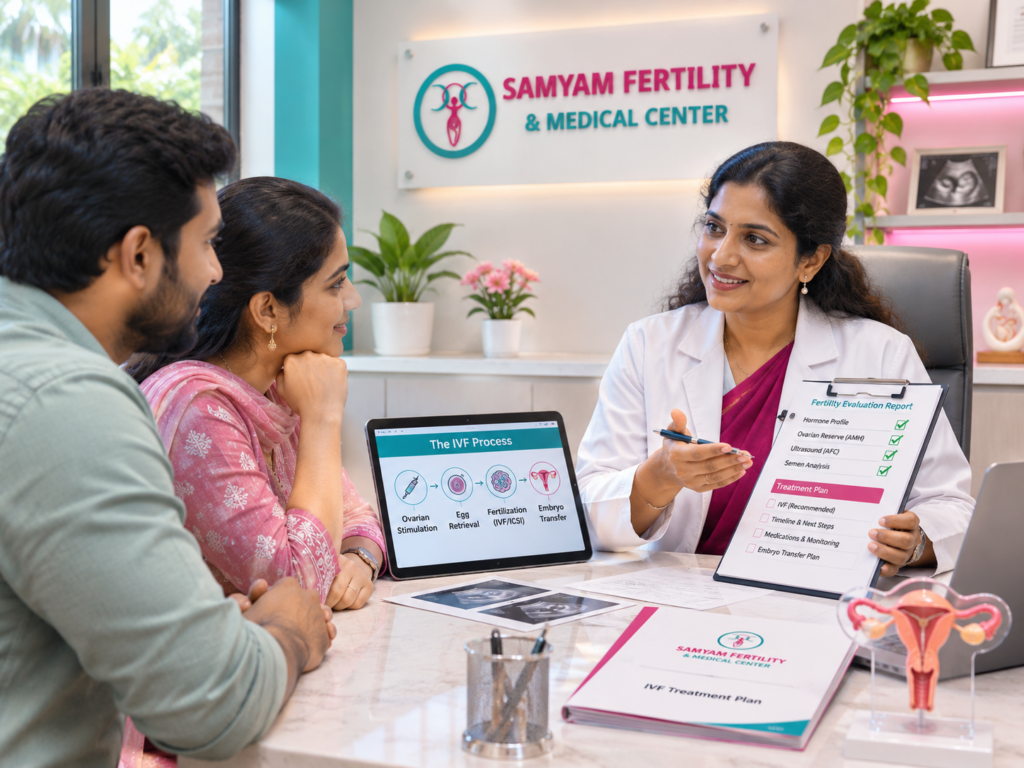
The first IVF consultation is an important step for couples considering assisted reproductive treatment. It provides an opportunity to discuss fertility concerns, review previous medical reports, understand possible causes of infertility and learn about available treatment options.
Many couples attending their first appointment have questions about IVF procedures, required tests, treatment duration, costs and the possibility of pregnancy. Understanding what happens during this consultation can help reduce uncertainty and make the appointment more productive.
If you are searching for an IVF Specialist in Electronic City, choosing a qualified medical professional who can explain your condition and treatment options is an important consideration.
At Samyam Fertility and Medical Center, Dr. Sowparnika S N, Consultant OBG and Fertility Specialist, provides consultations related to reproductive medicine and fertility care. Her qualifications include MBBS, DGO, DNB, Fellowship in Reproductive Medicine and MRCOG membership.
This article explains how to prepare for your first IVF appointment, what happens during the consultation and which questions couples should discuss before beginning treatment.
Why Is the First IVF Consultation Important?
IVF is a medical treatment that involves several stages, including ovarian stimulation, egg retrieval, fertilisation, embryo development and embryo transfer.
However, not every couple experiencing difficulty conceiving requires IVF.
The first consultation helps the doctor understand the couple’s reproductive health and determine whether IVF, IUI, ovulation induction or another approach may be appropriate.
During the appointment, the doctor may:
- Review the couple’s fertility history.
- Discuss the duration of attempts to conceive.
- Examine previous investigation reports.
- Identify possible factors affecting conception.
- Recommend additional diagnostic tests.
- Explain available treatment options.
- Discuss the expected treatment process.
An individualised assessment is important because fertility treatment should be based on clinical findings rather than a standard approach for every couple.
What Should You Carry for Your First IVF Appointment?
Preparing medical records before visiting an IVF Doctor in Electronic City or a nearby fertility center can make the consultation more useful.
Consider carrying the following documents.
1. Previous Ultrasound Reports
Previous pelvic ultrasound reports can provide information about the uterus, ovaries, endometrial lining, ovarian cysts and other pelvic findings.
If you have undergone follicular monitoring, carry those reports as well.
2. Hormonal Blood Test Results
If previously performed, bring reports for:
- AMH.
- FSH.
- LH.
- TSH.
- Prolactin.
- Other relevant reproductive hormone tests.
These results may help the doctor understand your hormonal and ovarian reserve status.
3. Semen Analysis Report
Male fertility evaluation is an important part of the IVF consultation.
Carry any previous semen analysis reports showing sperm concentration, motility and morphology.
If the results are abnormal, the doctor may recommend additional testing or a repeat semen analysis.
4. Previous IUI or IVF Treatment Records
Couples who have undergone previous fertility treatments should bring their medical records.
These may include:
- Previous stimulation protocols.
- Egg retrieval details.
- Number of eggs collected.
- Fertilisation reports.
- Embryo development reports.
- Embryo transfer details.
- Previous pregnancy test results.
These records help the doctor understand the response to previous treatment and consider possible next steps.
5. Medication and Medical History
Prepare a list of current medications, allergies, existing health conditions and previous surgeries.
Conditions such as thyroid disorders, diabetes, PCOS and endometriosis may influence fertility treatment planning.
What Happens During Your First IVF Consultation?
The consultation generally includes several discussions and medical assessments.
Step 1: Understanding Your Fertility History
The doctor may ask how long you have been trying to conceive and whether you have previously achieved pregnancy.
Other questions may include:
- How regular are your menstrual cycles?
- Have you experienced miscarriages?
- Have you undergone fertility treatment previously?
- Have you had pelvic infections or reproductive surgery?
- Are you taking any regular medications?
- Does either partner have an existing medical condition?
These questions help identify possible factors that may influence fertility.
Step 2: Evaluating Female Reproductive Health
The doctor may review menstrual history, ovulation patterns, previous pregnancy details and existing gynaecological conditions.
Depending on the available information, further assessment may include:
- Pelvic ultrasound.
- Ovarian reserve testing.
- Hormonal blood investigations.
- Uterine assessment.
- Fallopian tube evaluation.
Not every patient requires all these tests. The doctor recommends investigations based on individual findings.
Step 3: Evaluating Male Fertility
Male fertility assessment is equally important.
Semen analysis is commonly used to assess sperm concentration, movement and morphology.
If abnormalities are identified, the doctor may recommend repeat testing or additional assessment.
In selected situations, further evaluation by a male reproductive health specialist may be useful.
Step 4: Discussing the Possible Cause of Infertility
After reviewing the medical history and investigation reports, the doctor may discuss possible causes of difficulty conceiving.
These may include:
- Ovulation disorders.
- Reduced ovarian reserve.
- Blocked fallopian tubes.
- Endometriosis.
- Uterine abnormalities.
- Male-factor infertility.
- Combined fertility factors.
- Unexplained infertility.
Sometimes, further investigations are required before identifying the cause.
Step 5: Discussing Treatment Options
The doctor explains the treatment options that may be suitable based on the diagnosis.
These may include ovulation induction, IUI or IVF.
Couples should understand why a particular treatment is being recommended and whether alternative approaches are available.
What Questions Should You Ask an IVF Specialist?
The first consultation is an opportunity to clarify doubts and understand the treatment plan.
Here are important questions couples can consider asking.
1. What Is the Possible Cause of Our Infertility?
Understanding the possible reason for difficulty conceiving is an important starting point.
Ask the doctor which findings suggest a particular fertility issue and whether additional tests are needed.
2. Do We Really Need IVF?
IVF is not required in every case.
Ask whether ovulation induction, IUI or other treatment options may be appropriate before considering IVF.
3. Which Fertility Tests Are Necessary?
Ask about the purpose of each recommended test.
Understanding why an investigation is needed can help couples prepare for the next stage of treatment.
4. How Long Will the IVF Process Take?
The duration depends on the treatment protocol, ovarian response and whether fresh or frozen embryo transfer is planned.
Ask for an approximate timeline, including monitoring appointments and pregnancy testing.
5. What Are the Potential Risks of IVF?
IVF involves medical procedures and medications that may have side effects.
Ask about ovarian hyperstimulation syndrome, multiple pregnancy, complications related to egg retrieval and other risks relevant to your medical history.
6. What Are the Expected Treatment Costs?
Couples should understand the estimated financial requirements before starting treatment.
Ask whether the quoted amount includes medication, investigations, egg retrieval, laboratory procedures, embryo transfer and freezing, if required.
7. What Happens If the First IVF Cycle Is Unsuccessful?
Not every IVF cycle results in pregnancy.
Ask how the doctor will review an unsuccessful cycle and whether additional investigations or changes to the treatment plan may be considered.
8. How Many Visits Are Required?
IVF involves monitoring appointments, procedures and follow-up visits.
Understanding the expected schedule can help couples plan work, travel and other responsibilities.
What Are the Different Fertility Treatment Options?
During the consultation, the doctor may explain different treatment methods.
Ovulation Induction
Ovulation induction uses prescribed medication to support egg development and release.
It may be recommended for women who have irregular or absent ovulation.
The response may be monitored through ultrasound scans and other investigations.
Intrauterine Insemination (IUI)
IUI involves placing prepared sperm directly into the uterus around the time of ovulation.
It may be considered for selected couples depending on sperm quality, fallopian tube status and other clinical findings.
In Vitro Fertilisation (IVF)
IVF involves collecting eggs from the ovaries, fertilising them with sperm in a laboratory and monitoring embryo development.
A suitable embryo may then be transferred into the uterus.
IVF may be considered in cases involving blocked fallopian tubes, certain male-factor infertility conditions, selected cases of endometriosis and other clinical indications.
Couples can explore the treatment details through the Samyam Fertility and Medical Center website.
What Should You Know About IVF Success Rates?
One of the most common questions during the first consultation is whether IVF will result in pregnancy.
IVF outcomes vary depending on several factors.
These include:
- Age of the female partner.
- Ovarian reserve.
- Egg quality.
- Sperm quality.
- Embryo development.
- Uterine health.
- Underlying fertility diagnosis.
- Previous treatment history.
A general success-rate figure may not accurately represent an individual’s chances.
Couples should ask the doctor to explain the expected outcomes based on their specific medical findings.
It is also important to understand the difference between fertilisation, embryo development, implantation, clinical pregnancy and live birth. These are different stages and should not be treated as interchangeable measures of success.
No treatment can guarantee pregnancy.
How Can Couples Prepare Emotionally and Physically for IVF?
Fertility treatment can involve emotional, physical and financial considerations.
Preparing in advance may help couples manage the process.
Maintain a Healthy Lifestyle
A balanced diet, adequate sleep and regular physical activity support general health.
Avoid smoking and discuss alcohol consumption with the doctor.
Manage Existing Medical Conditions
Conditions such as thyroid disorders, diabetes and other chronic illnesses may require medical review before pregnancy.
Attend Regular Appointments
Following the prescribed treatment schedule is important, especially during ovarian stimulation and embryo transfer preparation.
Communicate With Your Partner
Fertility treatment involves decisions that affect both partners.
Discuss concerns, treatment expectations and practical responsibilities together.
Seek Emotional Support
It is normal to experience anxiety or uncertainty during fertility treatment.
Couples may benefit from counselling, supportive family members or professional guidance.
What Happens After the First IVF Consultation?
The next steps depend on the consultation findings.
If additional investigations are required, the doctor may recommend completing them before selecting a treatment plan.
Once the necessary reports are available, the doctor can discuss:
- The possible diagnosis.
- Whether IVF is suitable.
- The proposed treatment protocol.
- Medication and monitoring requirements.
- Expected appointments.
- Possible risks and limitations.
- Financial considerations.
- Follow-up arrangements.
Couples should take time to understand the recommendations and ask questions before providing consent for treatment.
Meet Your Fertility Specialist at Samyam Fertility and Medical Center
Couples searching for an IVF Clinic in Electronic City can explore fertility consultations and treatment services at Samyam Fertility and Medical Center, located in Chandapura, Bengaluru.
Dr. Sowparnika S N is the Consultant OBG and Fertility Specialist at the center.
Her qualifications include:
- MBBS.
- DGO.
- DNB.
- Fellowship in Reproductive Medicine.
- MRCOG membership.
She provides consultations related to reproductive health, fertility evaluation and treatment planning.
The center offers fertility-related services, including IVF and IUI, helping couples understand their available medical options.
If you are considering IVF Treatment in Electronic City, you can contact the center to enquire about a consultation and the services available at its Chandapura location.
Visit the official Samyam Fertility and Medical Center website or call +91 63662 53517 for appointment information.
Frequently Asked Questions
1. What should I expect during my first IVF consultation?
The first appointment generally includes a review of medical history, previous fertility reports, menstrual cycles, reproductive health and possible treatment options.
2. Should both partners attend the IVF consultation?
Yes. Both partners should ideally attend because infertility may involve male factors, female factors or a combination of both.
3. Do I need to complete all fertility tests before my first appointment?
No. You can bring any available reports. The doctor will decide whether additional investigations are necessary.
4. Is IVF recommended during the first consultation?
Not necessarily. The doctor first evaluates the couple’s fertility history and test results before recommending an appropriate treatment approach.
5. How long does an IVF consultation take?
The duration varies depending on the medical history, available reports and questions discussed. Couples should allow sufficient time for a detailed consultation.
6. What is the difference between an IVF doctor and a fertility specialist?
An IVF doctor generally focuses on assisted reproductive treatment, while a fertility specialist may evaluate and manage a wider range of reproductive health conditions, including infertility and assisted conception.
7. Can I undergo IVF if I have PCOS?
Some women with PCOS may require IVF, while others may conceive with ovulation induction or other treatments. The suitable approach depends on individual findings.
8. Who is the IVF specialist at Samyam Fertility and Medical Center?
Dr. Sowparnika S N is the Consultant OBG and Fertility Specialist at the center. Her qualifications include MBBS, DGO, DNB, Fellowship in Reproductive Medicine and MRCOG membership.
9. Where is Samyam Fertility and Medical Center located?
The center is located at 1st, SRT Building, Circle, Hosur Road, above Ujjivan Bank, Teachers Colony, Chandapura, Bengaluru, Karnataka 560099.
Conclusion
Your first IVF consultation is an opportunity to understand your fertility health, discuss possible causes of infertility and learn about suitable treatment options. Carrying previous medical records and preparing questions can help make the appointment more informative.
At Samyam Fertility and Medical Center, Dr. Sowparnika S N provides fertility consultations and guidance regarding reproductive health and assisted reproductive treatments.
Couples from Electronic City and nearby areas can contact the Chandapura center to discuss their fertility concerns and understand the next steps towards treatment.